Civil Litigation & Business Disputes
PA Foreclosure Defense & Mortgage Workout
Last updated August 2026
6 min read
✓ Verified Aug. 2026If you have fallen behind on your mortgage, you have more time and more options than you probably think. Pennsylvania has some of the strongest foreclosure protections in the country, and Bucks County’s foreclosure diversion program gives homeowners a meaningful opportunity to negotiate with their lender before any sheriff’s sale. Those protections only work if you respond; ignoring the process is how people lose their homes.
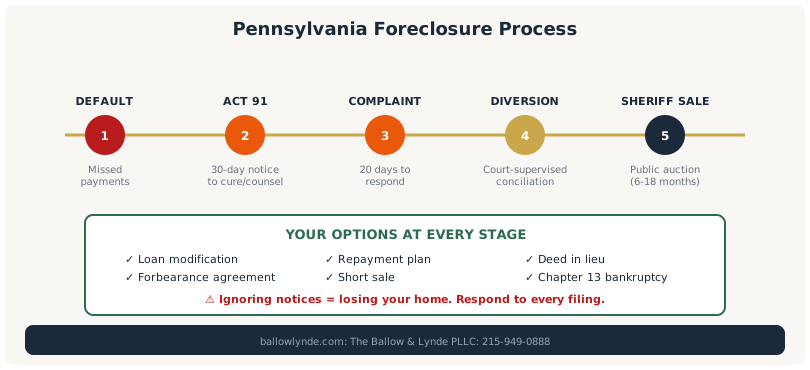
Pennsylvania is a judicial foreclosure state, meaning the lender must file a lawsuit and get a court order before selling your home. This process takes months (often more than a year), giving you time to explore alternatives.
In most residential foreclosures, before the lender can file a complaint it must send you an Act 91 notice , a formal letter telling you that you are in default, what you owe, and that you have 30 days to cure the default or apply for assistance. The notice must also tell you about free housing counseling services. That requirement has limits. The notice duty applies once you are at least 60 days behind on payments or in violation of another provision of the mortgage. The lender does not have to send the notice at all if you are more than 24 months in arrears, if your arrearages exceed $60,000, or if you were already sent an Act 91 notice and then did not apply for assistance, were denied, or had your assistance payments terminated (35 P.S. § 1680.403c(a), (f), (g)).
If the notice was required in your case and the lender did not send a proper Act 91 notice, or did not wait the required time before filing, the foreclosure complaint can be challenged with preliminary objections .
Once any required Act 91 notice period expires, the lender files a complaint in the Bucks County Court of Common Pleas. You have 20 days to respond ( Pa.R.C.P. 1026 ). If you do not respond, the lender can take a default judgment and proceed to sheriff’s sale.
Bucks County participates in a residential mortgage foreclosure diversion program. Once a foreclosure is filed on an owner-occupied residential property, the case may be referred to the diversion program, where a court-supervised conciliation conference brings the homeowner, the lender, and a housing counselor together to explore alternatives to foreclosure.
If no resolution is reached, the lender obtains a judgment and schedules the property for sheriff’s sale . Even after the sale is scheduled, you generally have a statutory right to reinstate a residential mortgage by paying the past-due payments (arrearages) plus reasonable fees and costs, not the entire accelerated balance, up to one hour before bidding begins at the sheriff's sale (up to three times per calendar year under 41 P.S. § 404). You can also stop a sale by paying the full payoff or by filing for bankruptcy. After the sale, the homeowner has a limited window to ask the court to set the sale aside; a petition to set aside the sale must be filed before the sheriff's deed is delivered (Pa.R.C.P. 3132). Pennsylvania does not require the court to confirm the sale; the sheriff executes and delivers the deed unless a timely petition to set it aside is filed (Pa.R.C.P. 3135).
Pennsylvania’s Vacant and Abandoned Real Estate Foreclosure Act provides an expedited foreclosure process for properties that have been certified as vacant and abandoned. This protects communities from blighted properties but also means that if you have left the property, the foreclosure can move much faster. If you are still living in the home, this act does not apply.
Don’t Wait
The single biggest mistake homeowners make is ignoring the mail. Every notice you receive is a deadline, and every deadline you miss reduces your options. If you are behind on your mortgage, contact a HUD-approved housing counselor (free) or an attorney as soon as possible. The earlier you engage, the more options you have.
Legal and factual content on this page was last verified: Aug. 2026. If you are reading this significantly after that date, confirm key provisions with current statute text or contact our office.
If you have been served with a complaint, the clock is already running: a defendant generally has 20 days to respond before the plaintiff can seek a default judgment. Free consultations available.
Book a Free Consultation Or call 215-949-0888