Real Estate & Property Law
PA Realty Transfer Tax Exemptions List
Last updated September 2026
7 min read
✓ Verified Sept. 2026Pennsylvania imposes a 1% state realty transfer tax on every transfer of real estate, and most municipalities add a 1% local tax (2% total is typical in Bucks County). But not every transfer is taxable. The Tax Reform Code (72 P.S. § 8102-C.3) lists exemptions that can save thousands of dollars, if you know they exist and structure the transaction correctly.
For the basic calculation, see our Realty Transfer Tax page and Transfer Tax Calculator .
The full statutory list of "excluded transactions" is at 72 P.S. § 8102-C.3, supplemented by the Department of Revenue regulations at 61 Pa. Code § 91.193. The categories below cover every common exemption Bucks County practitioners encounter at recording. Detailed explanations follow the table.
| Exemption | One-Line Description | Citation |
|---|---|---|
| Spouse to spouse | Transfers between husband and wife, including additions and removals from the deed | 72 P.S. § 8102-C.3(6); 61 Pa. Code § 91.193(b)(6) |
| Parent to/from child | Includes stepparent/stepchild and the child's spouse; either direction | 72 P.S. § 8102-C.3(6) |
| Grandparent to/from grandchild | Lineal transfer up or down the family tree, including the grandchild's spouse | 72 P.S. § 8102-C.3(6) |
| Sibling to sibling | Brother/sister and their spouses (added by Act 85 of 2012); one-year clawback applies to any family-exemption transfer regifted to a non-exempt party | 72 P.S. § 8102-C.3(6) |
| Divorced former spouses | Transfers between ex-spouses, if the property was acquired by both spouses, or by either spouse, before or during their marriage | 72 P.S. § 8102-C.3(6); 61 Pa. Code § 91.193(b)(6)(i)(F) |
| Estate to beneficiary | Distribution of estate real property from the personal representative to heirs or devisees per will or intestacy | 72 P.S. § 8102-C.3(7); 61 Pa. Code § 91.193(b)(7) |
| Division in kind (inherited property) | Division of inherited property among co-tenants for no or nominal consideration; tax due on any excess share | 72 P.S. § 8102-C.3(5); 61 Pa. Code § 91.193(b)(5) |
| Revocable living trust | Settlor to own living trust (8.1); trust back to settlor (9.2); trust to devisee/beneficiary after settlor's death (9.1) | 72 P.S. § 8102-C.3(8.1), (9.1), (9.2); 61 Pa. Code § 91.193(b)(32) through (34) |
| Ordinary trust | To a trustee where a direct transfer to all possible beneficiaries would be exempt; from trustee to a named or qualifying beneficiary | 72 P.S. § 8102-C.3(8), (9); 61 Pa. Code § 91.193(b)(8) through (9) |
| Successor trustee | Transfer that merely substitutes or adds a trustee | 72 P.S. § 8102-C.3(10); 61 Pa. Code § 91.193(b)(10) |
| Confirmatory / corrective deed | Deed for no or nominal consideration that corrects or confirms a previously recorded transfer without changing legal title | 72 P.S. § 8102-C.3(4); 61 Pa. Code § 91.193(b)(4) |
| Government transfers | Gift, dedication, or condemnation-related transfers to the Commonwealth or its subdivisions; tax-delinquent property acquired by a municipality at sheriff or tax claim bureau sale | 72 P.S. § 8102-C.3(1), (3); 61 Pa. Code § 91.193(b)(1), (3) |
| Religious organizations | Transfers between religious organizations, if the property has not been used for commercial purposes | 72 P.S. § 8102-C.3(17); 61 Pa. Code § 91.193(b)(17) |
| Mortgage holder in foreclosure | Deed in lieu of foreclosure to a bona fide mortgage holder in default, or judicial sale where the mortgage holder is the successful bidder (not an assignee of the bid) | 72 P.S. § 8102-C.3(16); 61 Pa. Code § 91.193(b)(16) |
| Mortgage / security instrument | A mortgage or instrument given as security for a debt is a financing transaction, not a taxable transfer | 72 P.S. § 8101-C (definition of "document"); 61 Pa. Code § 91.193(b)(23) |
| Lease (under 30 years) | Lease for a term shorter than 30 years, counting fixed-rent renewal options (30+ year leases are taxable) | 72 P.S. § 8101-C (definition of "title to real estate"); 61 Pa. Code § 91.193(b)(24) |
| Utility easement | Easement to a public utility used in furnishing utility service (ordinary easements for consideration are taxable) | 61 Pa. Code § 91.193(b)(28) |
| Principal / agent / straw party | Transfers between principal and agent or straw party where a direct transfer would be exempt | 72 P.S. § 8102-C.3(11); 61 Pa. Code § 91.193(b)(11) |
| Entity to its owner | Distribution from a corporation or association to an owner, only if the owner's share matches their ownership percentage and the stock/interest was held more than 2 years. There is no exemption in the other direction (owner into entity) | 72 P.S. § 8102-C.3(13); 61 Pa. Code § 91.193(b)(13) |
| Statutory merger / consolidation | Transfer by operation of law under a statutory merger or consolidation (or division of a nonprofit), unless the primary intent is tax avoidance | 72 P.S. § 8102-C.3(12); 61 Pa. Code § 91.193(b)(12) |
| Family farm business | Transfer of real estate devoted to the business of agriculture to a family farm business where the same family directly owns at least 75% of the entity | 72 P.S. § 8102-C.3(19); 61 Pa. Code § 91.193(b)(19) |
| Family transfers of entity interests | Transfer between members of the same family of an ownership interest in a real estate company or family farm business | 72 P.S. § 8102-C.3(20); 61 Pa. Code § 91.193(b)(20) |
| Conservancies / conservation easements | Transfers to conservancies; agricultural conservation, historic preservation, public trail, scenic, and open-space easements under PA preservation programs | 72 P.S. § 8102-C.3(18); 61 Pa. Code § 91.193(b)(18) |
| Industrial development authority | Transfers to a nonprofit IDA, and from an IDA to a qualifying industrial grantee | 72 P.S. § 8102-C.3(14), (15); 61 Pa. Code § 91.193(b)(14) through (15) |
| Volunteer fire / EMS / rescue | Transfers to or by a volunteer EMS, fire, or rescue company | 72 P.S. § 8102-C.3(23) |
| Land bank | Transfers to or by a land bank under 68 Pa. C.S. § 2103 | 72 P.S. § 8102-C.3(24) |
| Coal, oil, gas, mineral leases | Leases for production or extraction of coal, oil, natural gas, or minerals, and assignments thereof | 72 P.S. § 8102-C.3(22); 61 Pa. Code § 91.193(b)(22) |
| De minimis | Transaction where the tax due is one dollar or less | 72 P.S. § 8102-C.3(21) |
Subsection numbers refer to 72 P.S. § 8102-C.3 as amended through January 1, 2025, cross-referenced where applicable to 61 Pa. Code § 91.193, the Department of Revenue's implementing regulation. Citations on this page were verified against the source text of both provisions in June 2026. Always confirm the current numbering and any recent amendments before relying on a specific subsection.
One wrong box on the Statement of Value can cost you the full 2% tax. Marc Lynde reviews the deed and confirms the right exemption before you record in Bucks County.
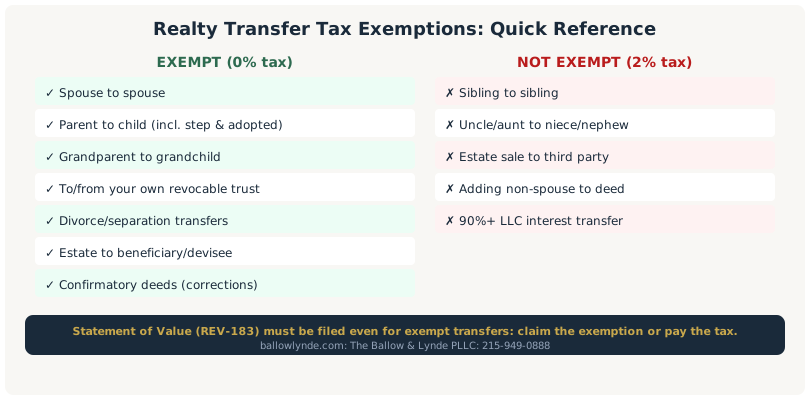
Transfers between the following family members are exempt :
The sibling exemption was added by Act 85 of 2012 (P.L.751, No.85), effective July 2, 2012, amending 72 P.S. § 8102-C.3(6). The one-year clawback applies to any transfer claimed under the family exemption of 72 P.S. § 8102-C.3(6) (61 Pa. Code § 91.193(b)(6)), not just sibling transfers: if the grantee transfers the property to a non-exempt party within one year, the subsequent transfer is taxed as if the original grantor made it directly.
For a deeper look at family transfers specifically, including worked examples for each relationship and the mechanics of the one-year clawback, see PA Realty Transfer Tax: Family Transfers .
Transfers to or from a revocable living trust are exempt when the settlor is the beneficiary during the settlor’s lifetime. This includes:
Transfers to irrevocable trusts may or may not be exempt depending on the trust structure and the relationship between settlor and beneficiaries.
Transfers between current spouses are exempt without condition. Transfers between former spouses are exempt only where the realty was acquired by both spouses, or by either spouse, before or during their marriage (61 Pa. Code § 91.193(b)(6)(i)(F)). Pennsylvania does not require the transfer to be pursuant to a court order or written agreement, nor that it be incident to the divorce.
Transfers from a decedent ’s estate to beneficiaries or devisees are exempt, but only to the extent the transfer is pursuant to the will or intestacy laws. A sale of estate property to a third party is not exempt .
This is where people most often guess wrong, and the guess is expensive. Pennsylvania treats an LLC, corporation, or partnership as a separate person from its owners. A deed from an individual into an entity is fully taxable even if that individual owns 100% of the entity, and even if no money changes hands (61 Pa. Code § 91.154). Unlike New York and some other states, Pennsylvania has no "mere change of identity" or "same beneficial ownership" exemption for deeds into your own company.
The narrow exceptions that do exist run mostly in the other direction or apply to special situations: a distribution from an entity to an owner is exempt only if the owner takes a share matching their ownership percentage and has held the stock or interest for more than two years (72 P.S. § 8102-C.3(13)); transfers by operation of law under a statutory merger or consolidation are exempt unless done primarily to avoid the tax (72 P.S. § 8102-C.3(12)); and real estate devoted to the business of agriculture can pass into a family farm business that the same family at least 75% owns (72 P.S. § 8102-C.3(19)).
Separately, selling the entity instead of the property does not avoid the tax. If 90% or more of a "real estate company" changes hands within three years, the company is treated as acquired and the tax is due on the real estate it holds, computed from assessed value times the common level ratio, with no deed required (72 P.S. § 8102-C.5; 61 Pa. Code § 91.202).
Statement of Value: Know Which Exemptions Require It
For most exempt transfers, you must file a Statement of Value with the Recorder of Deeds identifying the exemption you are claiming. If you do not file or claim the wrong exemption, you may be assessed the full tax plus interest. A transfer that is wholly exempt on family relationship is excused from that filing requirement under 72 P.S. § 8109-C(a), though the Department of Revenue recommends filing one anyway.
Do not pay tax you do not owe. If you are transferring property in Bucks County and want to confirm the right exemption before you record, schedule a consultation or call 215-949-0888.
Legal and factual content on this page was last verified: Sept. 2026. If you are reading this significantly after that date, confirm key provisions with current statute text or contact our office.
Free consultations available for most practice areas.
Book a Free Consultation Or call 215-949-0888